


Purchasing the right vessel for your beverage service involves far more than picking a stylish design. When buyers ask about dimensions, they often uncover a complex web of variables. Regional measurement standards, material thicknesses, and daily operational demands dictate the true size and utility of any vessel. Improper sizing leads to inconsistent pours, excess foam waste, and storage nightmares behind the bar. We aim to provide an evidence-based breakdown of standard volumes, physical dimensions, and commercial evaluation criteria. You will learn how to navigate international capacity standards and avoid common procurement mistakes. We also explore essential maintenance realities for both B2B hospitality environments and premium B2C use. Armed with this knowledge, you can make highly accurate purchasing decisions. You will optimize bartender efficiency, ensure beverage quality, and protect your investment over the long term.
Standard Sizing Ranges: Most commercial glass mugs range from 12 oz to 22 oz, while traditional German steins typically hold 0.5 Liters (16.91 oz) to 1 Liter (33.81 oz).
Measurement Standards Vary: American capacities are usually measured "brimful" (to the rim), whereas European and German glassware uses a designated "fill line" to accommodate foam.
Operational Impact: Upsizing to 22 oz or 32 oz capacities reduces refill frequency in high-volume settings, but requires specific ergonomic considerations (e.g., handle width and heavy-duty bases).
Maintenance Risks: Custom-printed mugs require specific care; commercial dishwashing with acidic cleaners can degrade screen-printed enamels over time.
Understanding volume capacities is the first step in successful procurement. Commercial drinkware falls into three distinct data-driven sizing tiers. You must align these tiers with your specific service model.
The standard pub and craft sizes represent the industry baseline. These vessels typically range from 12.68 ounces to 16 ounces. The 12.68-ounce mark serves as a standard craft pour. It allows venues to control costs on premium, high-ABV beverages. Meanwhile, the 16-ounce capacity functions as the classic American pint equivalent. It remains the most common choice for everyday dining.
High-efficiency sizes step up the volume to 20 or 22 ounces. Industry veterans often call these "bomber" sizes. They are ideal for reducing bartender refill rates during peak rushes. By offering a larger initial pour, you keep customers satisfied longer. This directly reduces labor strain in high-volume sports bars.
Oktoberfest and extra-large sizes push capacities to 32 or 34 ounces. This roughly equals one liter. These massive vessels feature heavy-duty thick glass. The thick walls safely support the immense weight of the liquid.
Below is a quick reference table outlining these baseline capacities:
Capacity Tier | Standard Volume (oz) | Metric Equivalent (mL) | Primary Commercial Use Case |
|---|---|---|---|
Standard Craft / Pub | 12.68 oz – 16.0 oz | ~375 mL – 473 mL | Tasting rooms, standard casual dining |
High-Efficiency "Bomber" | 20.0 oz – 22.0 oz | ~590 mL – 650 mL | Sports bars, high-turnover venues |
Oktoberfest / Extra-Large | 32.0 oz – 34.0 oz | ~946 mL – 1000 mL | Festivals, traditional German lagers |
Physical footprint matters just as much as liquid volume. Let us look at the 16-ounce benchmark. An average 16-ounce vessel stands about 6.125 inches tall. It has a main body diameter of 3.5 inches. However, the overall width requirement reaches approximately 5 inches once you include the handle. You must calculate this 5-inch metric carefully. It heavily impacts bar shelving limits and storage space calculations.
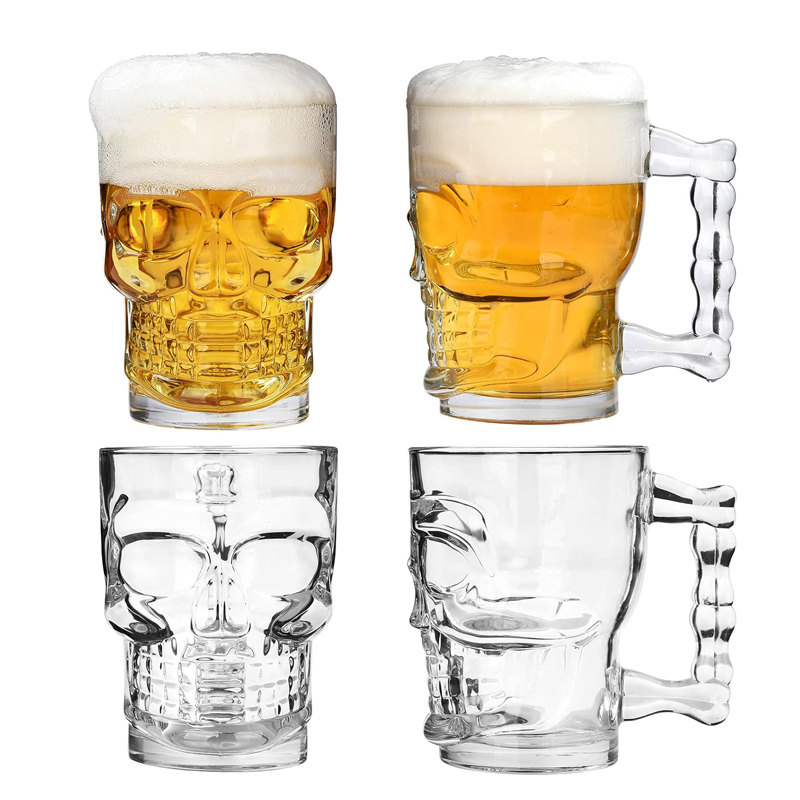
Sourcing durable beer mugs requires navigating international measurement standards. Buyers frequently fall into the measurement trap. They assume a stated capacity guarantees a perfect pour. It usually does not.
The United States standard calculates volume to the absolute brim. Manufacturers measure the liquid right up to the glass edge. If you pour exactly 16 ounces of beer into a 16-ounce American glass, you leave zero room for a proper head. Bartenders must short-pour the liquid to accommodate the foam. This can lead to customer complaints about undersized drinks.
The European and German measurement standard takes a completely different approach. They utilize a designated "fill line" indicator. A traditional 0.5L (16.91 oz) or 1L stein is designed to hold that exact liquid volume well below the rim. The manufacturer deliberately leaves 1 to 1.5 inches of un-dimpled headspace at the top. This smooth band exists specifically for optimal foam retention. The true "brimful" capacity of a German vessel is always significantly higher than its advertised fill line.
You also face the dreaded "pint" discrepancy. Ordering based on generic terminology invites disaster. An American liquid pint equals exactly 16 ounces. Conversely, an Imperial pint holds 20 ounces. British pubs and international cruise lines rely heavily on the 20-ounce standard. If you order generic pints for a UK-themed pub, you might receive undersized glassware. Always standardize your procurement around precise ounces or milliliters. Never rely on localized names.
Evaluating design goes beyond aesthetics. Material density and construction techniques directly influence user experience and operational longevity.
Glass construction offers unique benefits. When evaluating standard options, look for paneled designs and dimpled textures. Dimples define the traditional German style. They are not just decorative. These features add visual bulk and structural integrity. They achieve this without drastically increasing the empty weight. You should also prioritize hollow bases. A hollow base distributes weight better and reduces manufacturing costs.
If you prefer commissioning custom ceramic steins, you face harsh manufacturing realities. Sourcing custom stoneware requires calculating clay shrinkage accurately. Raw clay shrinks significantly during the kiln firing process. You must factor this into your initial specs.
Here is the standard mathematical process for custom ceramic sizing:
Identify Target Volume: Determine the exact capacity you need (e.g., 16 oz).
Calculate the Shrinkage Rate: Assume a standard 12% shrinkage rate for commercial stoneware clay.
Apply the Formula: Divide your target size by 0.88 (Target Size / 0.88 = Initial Build Size).
Allocate Raw Materials: Understand material limits. A finished 16 to 18-ounce ceramic piece requires roughly 1.25 pounds of raw clay before firing.
Ergonomics play a massive role in user experience. Handle design is absolutely critical for heavy vessels holding 22 ounces or more. A fully loaded 32-ounce liter feels incredibly heavy. The handle diameter must measure between 3.5 to 4 inches. This specific sizing provides the most stable center of gravity. It allows patrons to drink comfortably using just one hand.
Buying commercial glass mugs introduces specific maintenance challenges. Durability claims often mask hidden operational risks. You must train your staff to handle these items correctly.
Thermal shock stands out as the primary threat. Manufacturers routinely market thick vessels as "freezer safe." However, improper frosting procedures destroy them rapidly. Staff often stack wet glasses directly inside commercial freezers. This causes the glass to freeze together. Prying them apart creates invisible micro-fractures. Sudden temperature changes—like pouring hot wash water into a frozen glass—cause those fractures to shatter. You must evaluate whether your operational flow allows for proper individual spacing inside freezers.
Custom decals face their own specific hazards. Many venues invest in beautiful, screen-printed logos. Commercial screen printing involves firing enamels onto the glass at roughly 1150°F. While this sounds durable, it remains highly vulnerable to chemical attacks.
The acid risk is severe. High-acidity detergents rapidly degrade screen-printed enamels over time. Many modern commercial dishwashers rely on citric acid-based cleaners to remove hard water stains. These acids eat away at the logo, causing premature fading and discoloration.
You can mitigate this risk easily. Specify Citric Acid Proof Series (CAPS) enamels when ordering custom prints. CAPS enamels resist chemical degradation beautifully. If CAPS is unavailable, opt for unprinted, heavy-duty glass instead of risking a faded brand image.
Finalizing your procurement list requires a structured approach. You must weigh three primary factors: service volume, beverage matching, and spatial limits.
First, define your service volume strategy. Choose 12 to 16-ounce capacities for high-turnover establishments. They work perfectly for tasting-focused menus and craft breweries. Select 20 to 22-ounce sizes for high-volume sports bars. This strategy optimizes bartender efficiency during major televised events.
Next, focus on beverage matching. You should match heavy, dimpled steins exclusively with traditional lagers and festbiers. These styles thrive in large, cold vessels. Conversely, reserve thinner-walled, stemmed, or shaker options for specialty ales. Aromatic IPAs and Belgian ales require a different glass shape. Aroma capture takes priority over sheer liquid volume for these styles.
Finally, address storage and stackability. Handled vessels demand immense physical space. Recognize they cannot be stacked like standard shaker or nonic pint glasses. A stacked tower of handles becomes dangerously unstable. Calculate your linear shelf space carefully. Use the 5-inch width metric we discussed earlier. Multiply 5 inches by your target inventory count. Do this before placing any bulk orders to ensure your backbar can handle the footprint.
Buying the ideal beverage vessel requires balancing true liquid capacity with structural durability. You must differentiate between "brimful" American measurements and European "fill line" standards. Ignoring this distinction leads to inaccurate pours and frustrated customers. Procurement also demands a close look at maintenance realities, especially regarding thermal shock and acidic detergents.
We recommend conducting a physical sample test before committing to a massive commercial order. Request a single unit from your supplier. Evaluate the handle ergonomics carefully. Test the actual pour volume while intentionally leaving a 1-inch foam head. Finally, run the sample through your commercial dishwasher several times to verify its durability.
A: Most standard restaurant glass mugs hold between 12.5 and 16 ounces, though 22-ounce variations are common in pubs.
A: German steins are measured to a specific fill line to leave room for the foam head, meaning the "brimful" capacity is actually higher than the stated 0.5 Liters.
A: Lightly dampen the glass and place it individually in a freezer, ensuring it does not touch other items to prevent sticking and localized thermal shock.
A: While the heavy glass itself is dishwasher safe, custom screen-printed logos can degrade rapidly if commercial detergents containing citric acid are used.


