
Views: 0 Author: Site Editor Publish Time: 2026-09-30 Origin: Site


Sourcing custom shot glasses wholesale requires balancing unit economics with brand presentation. You might buy them for high-end corporate events, retail merchandise displays, or massive promotional giveaways. The stakes run high when you order at scale. While this category often seems highly commoditized, hidden variances in material quality can quickly derail your procurement budget. Print durability and fulfillment logistics also play major roles in your campaign's ultimate success. You need to understand these subtle nuances before committing to a massive purchase order. This guide breaks down the essential technical specifications required to make an informed bulk purchase. We thoroughly explore various customization methods and detail the critical vendor evaluation criteria. You will learn how to navigate complex material choices and maximize print longevity. Ultimately, this knowledge ensures a risk-free transaction that elevates your brand identity and delights your end users.
Customization dictates longevity: Laser etching offers permanent, dishwasher-safe branding, while screen printing supports brand colors but requires specific curing to prevent fading.
Specs matter for ROI: Standardizing artwork (vector, 300+ DPI) and understanding print area dimensions prevents costly pre-production delays.
Compliance: Commercial drinkware must meet FDA standards and (if applicable) California Proposition 65 requirements.
We must first establish the core use case to determine your budget per unit. Aligning the product to its intended purpose drives every subsequent purchasing decision. Buying without a clear strategy often results in wasted marketing spend.
Corporate Gifting and Executive Swag: High perceived value matters most here. You want heavy base glass featuring precision-etched logos. It feels premium in hand and communicates stability. Clients keep these on their desks or in home bars for years.
High-Volume Promotions and Festivals: Durability and safety take priority over luxury. Organizers often choose shatterproof acrylic or stainless steel paired with durable pad printing. You cannot risk broken glass in crowded outdoor environments.
Retail and Souvenir Merchandise: Unique form factors sell best in souvenir shops. Tall shooters and multi-color decals attract tourist dollars. The visual impact drives the impulse purchase.
Next, consider budgeting realities. You must differentiate between the base unit cost and your fully landed cost. Base pricing deceives many first-time buyers. A blank glass might cost a few cents, but that ignores the production reality. You must account for setup fees, run charges for extra ink colors, and heavy freight costs. Accurately mapping these variables ensures you stay within strict budget constraints. Purchasing Custom Shot Glasses Wholesale requires calculating these hidden costs upfront to guarantee a profitable campaign.
Choosing the right material impacts both user experience and event safety. Standard glass offers a traditional, familiar feel. However, evaluating thickness and weight remains critical. A heavy base glass usually ranges from 1.5 ounces to 2 ounces. The manufacturing process gathers more molten glass at the bottom of the mold. This lowers the center of gravity. It prevents accidental tipping during fast-paced bartending and dramatically increases the premium feel.
Sometimes, traditional glass does not fit the environment. Alternative materials solve specific logistical challenges.
Acrylic and Polystyrene: These plastics are entirely shatterproof. They are ideal for outdoor events, poolsides, and strict liability reduction. Polystyrene offers an economical clear option. Higher-end plastics like SAN (Styrene Acrylonitrile) provide better resistance to clouding and crazing in dishwashers.
Stainless Steel: This metal offers extreme durability. It resists rust and drops. It pairs beautifully with laser engraving for a sleek, modern aesthetic popular in tech industry swag.
Capacity variations also dictate the final product shape. We commonly see standard sizes around 1.5 ounces. Fluted glasses often hold 2 ounces, while tall shooters exceed 2.5 ounces. Waitstaff prefer slightly oversized glasses. A 2-ounce glass holding a 1.5-ounce pour prevents surface-tension spills on crowded trays. If you need precise liquid measurements for custom recipes, you must calculate exactly how many ml in a shot glass to match your chosen capacity perfectly.
Material Specifications Chart
Material Type | Best Use Case | Durability Profile | Weight and Feel |
|---|---|---|---|
Standard Glass | Restaurants, Dive Bars | Moderate | Medium |
Heavy Base Glass | Corporate Gifting, Upscale Bars | High | Heavy/Premium |
Acrylic/Plastic | Outdoor Festivals, Poolside | Shatterproof | Very Light |
Stainless Steel | Modern Swag, Camping | Extreme | Medium |
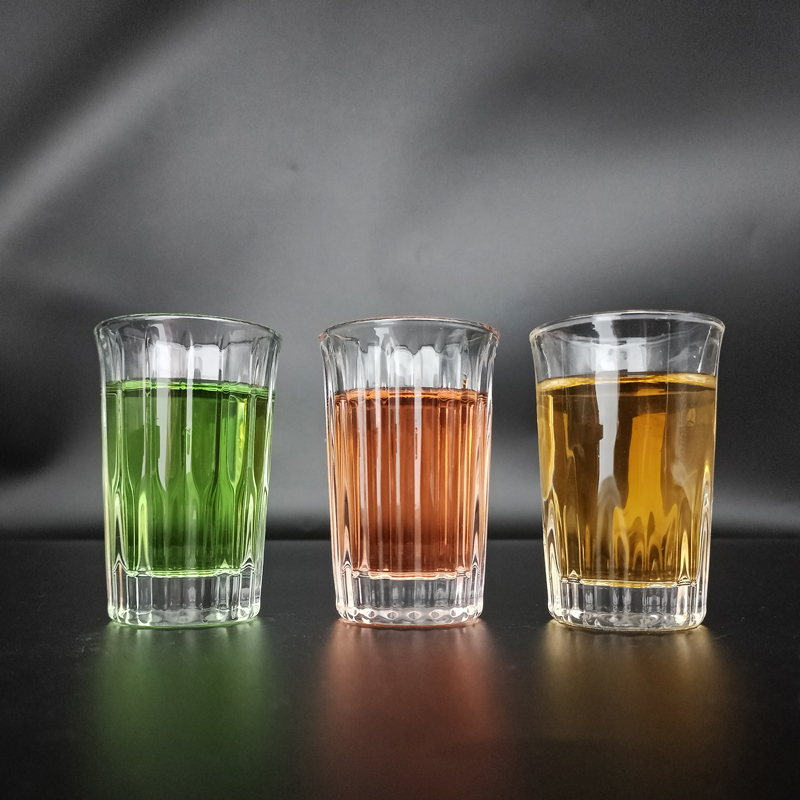
Your chosen printing method determines how long the branding survives. Laser etching and engraving actually remove the top layer of material. This mechanism creates a frosted, recessed look by microscopically fracturing the glass surface. The pros are undeniable. It remains permanent and entirely dishwasher safe. B2B buyers frequently request this technique for its high perceived value. However, the cons include a monotone finish without brand colors. It also carries a higher cost per unit at lower volumes due to machine time.
Screen printing and pad printing operate differently. The mechanism applies ink directly to the glass surface. Screen printing uses specialized jigs to rotate the curved glass while a squeegee forces ink through a fine mesh. The biggest pro is exact Pantone (PMS) color matching. It proves highly scalable for massive wholesale orders. The main con involves durability limits. The ink remains susceptible to scratching or fading in commercial dishwashers if not properly cured. Always specify ceramic inks over organic inks if the glasses will face high-temperature commercial sanitation.
Full-color wraps or decals suit very specific needs. You would use them for complex, multi-color artwork or photographic logos. Unfortunately, they carry strict limitations. They are often hand-wash only. They also present a higher risk of peeling over time as water degrades the adhesive backing. We recommend decals strictly for souvenir items rather than heavy-use barware.
Technical requirements often bottleneck bulk orders. Strict design and file requirements prevent blurry logos on the final product. You must mandate the use of Vector files like .AI or .EPS. Vector files scale infinitely without losing resolution. If you must use high-resolution rasters, they require a strict minimum of 300 DPI. Rasterization often ruins fine text on small glass surfaces.
You also need to understand maximum print area dimensions. A typical 1.5-ounce tapered glass might only offer a 1.25-inch by 1.25-inch safe print area. Width versus height constraints become tricky on curved surfaces. Pushing artwork beyond this margin causes severe visual distortion as the glass tapers inward.
Minimum Order Quantities (MOQ) dictate your supplier choices. Vendors establish standard wholesale tiers at 72, 144, 250, or 500 units. You should analyze price breaks across these specific tiers. Suppliers operate kilns and printing presses that require significant setup time. Ordering 144 units often yields a massive cost reduction per unit compared to ordering just 72. You might find a much more cost-effective order volume just slightly above your initial headcount.
The proofing process acts as your final safety net. You should weigh the necessity of digital proofs against physical pre-production samples (PPS). Digital proofs work perfectly for simple, one-color logos. However, physical samples remain vital for large-scale corporate orders. They let you verify color accuracy, ink opacity, and print alignment before authorizing mass production.
Logistics often destroy a well-planned budget. Breakage allowances and shipping demand intense scrutiny. Glassware is inherently heavy and fragile. You must assess vendor policies regarding transit damage before signing a purchase order. The standard industry allowance for breakage sits around 2% to 5%. You should strategically over-order by 5% to ensure you have enough flawless units for your event.
Freight calculations require particular attention. You must evaluate dimensional weight versus actual scale weight. Freight carriers calculate dimensional weight by multiplying the carton's length, width, and height, then dividing by a standard dimensional factor. Since shot glasses ship in heavily padded, bulky cartons to prevent shattering, their dimensional weight frequently exceeds their actual weight. This dramatically inflates shipping costs.
Hidden fees require a thorough audit. Watch out for separate screen or setup charges per color. Unboxing fees, drop-shipping fees, and residential delivery surcharges also surprise many first-time buyers. Request a fully itemized quote.
Compliance and safety separate reputable vendors from severe legal liabilities. Verify that plastic materials are certified BPA-free. Ensure you source lead-free glass and non-toxic inks. Commercial drinkware must strictly comply with federal FDA regulations. When shipping to California, Proposition 65 compliance becomes a strict legal necessity. This law mandates warnings if products contain heavy metals historically found in colored glass enamels. Sourcing reliable Customized Glass Products ensures you meet all these critical safety frameworks seamlessly.
Sourcing custom shot glassware successfully demands strict attention to detail. You must match the material and print method to the end-user's environment. You must also strictly audit all landed costs to avoid surprise freight and setup charges. Take these immediate actionable steps to secure a flawless bulk order. First, consolidate your artwork into high-resolution vector files. Second, determine your firm in-hands date to map out production timelines accurately. Third, request a physical pre-production sample or a detailed spec sheet from your shortlisted vendors. Finally, clarify exact breakage policies and freight calculations before finalizing the transaction.
A: Standard production generally requires 7 to 14 business days after you approve the final digital proof. You must also factor in transit time, which adds 3 to 5 days depending on your location. Many vendors offer rush production options for an additional fee if you face a strict event deadline.
A: It depends heavily on the chosen print method. Laser-etched glasses are permanently dishwasher safe. Screen-printed glasses usually survive residential dishwashers, but harsh commercial sanitizers often cause fading over time. We recommend hand washing full-color decals to prevent premature peeling.
A: Most wholesale vendors include a standard 2% to 5% breakage allowance in their terms. They will usually issue a prorated credit for broken units exceeding this threshold. Vendors rarely ship physical replacements for small quantities due to the prohibitively high cost of freight.
A: Wrap-around designs face technical limitations on standard tapered shot glasses. The curve naturally distorts straight artwork as it wraps around the perimeter. Cylindrical shooters handle full wraps much better. If you use a tapered glass, you must specifically warp the artwork file to compensate for the angle.


